
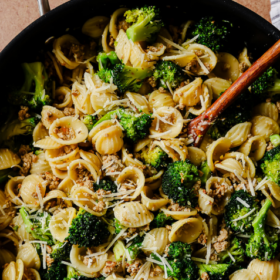
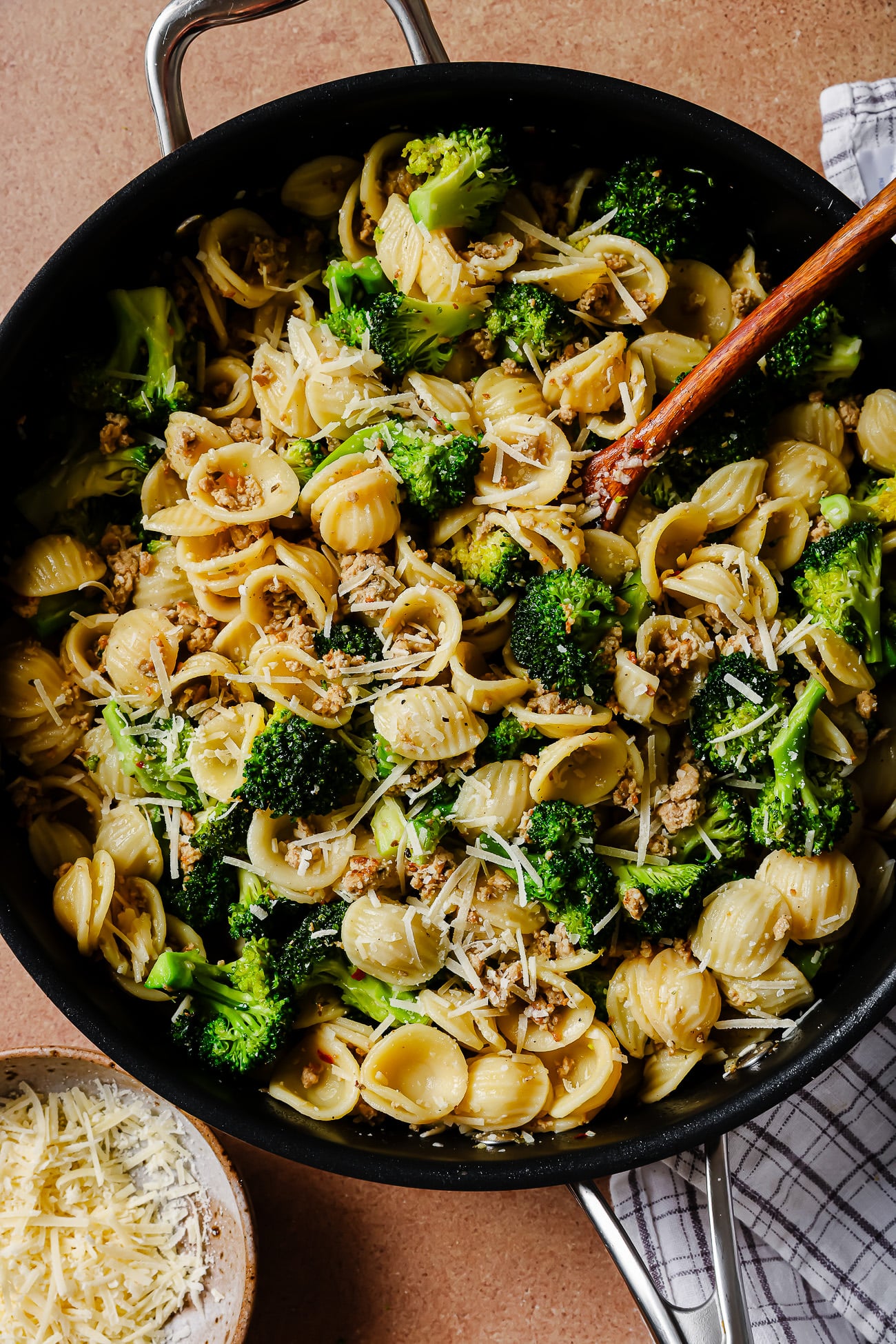
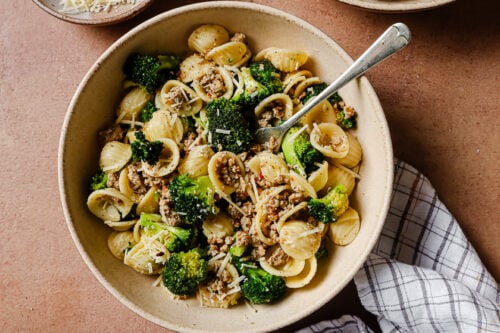
Orecchiette with sausage and broccoli is one of those pasta dishes that looks like it came straight from a restaurant but comes together in a single skillet in about 30 minutes. The pasta soaks up all the savory flavors from the sausage, garlic, and tender broccoli, creating a simple but incredibly satisfying sauce that coats every little “ear” of pasta perfectly. Finished with a touch of butter and freshly grated Pecorino Romano, this is the kind of weeknight dinner that always earns seconds.


Olivia’s Personal Note
My family and I have been making sausage pasta on busy weeknights for as long as I can remember. It is the kind of meal that comes together fast, fills everyone up, and never leaves leftovers. When I decided to make this orecchiette with sausage and broccoli, I already knew it was going to work. What I did not expect was how quickly it would become the most-requested version.
We are a big broccoli family, which helps. The florets cook right in the sauce, soaking up all the garlicky, savory liquid until they are tender but still have a bite. By the time everything is tossed together, Thomas does not even think twice about the broccoli. His exact words the first time I made this: “Who doesn’t like broccoli, mommy?” I consider that a win. If you love cooking with Italian sausage, my Baked Ziti with Ground Beef is another weeknight recipe that uses it in a completely different way and is just as easy to pull together.
I usually serve this with my simple Arugula Salad with Lemon Dressing to balance the richness of the sauce, and a good Garlic Bread on the side for everyone who wants to soak up what is left in the bowl.
Key Ingredients:
All ingredients and their amounts are listed in the recipe card at the bottom of this post.
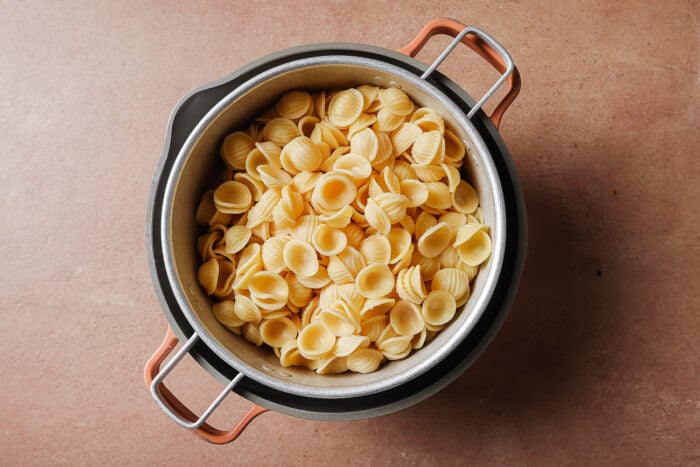
Orecchiette: The pasta shape here is not decorative. Orecchiette, which means “little ears” in Italian, has a concave shape with a slightly thicker rim. That cup catches and holds the crumbled sausage, broccoli bits, and sauce in a way that a flat pasta like linguine or a smooth penne never could. I recommend cooking it to just barely al dente because it will continue absorbing the sauce when you toss everything together. If you cannot find orecchiette at your grocery store, small pasta shells are the best substitute. They have a similar cupped shape that holds sauce well. But you can also use fusilli, farfalle or ziti.
Italian Sausage (sweet or spicy): I like to use sweet Italian sausage when I am making this for the whole family, and spicy when it is just Pierre and me. Remove the casings before cooking and break the meat into irregular pieces rather than uniform crumbles. The irregular pieces create more surface area for browning, which means more of those deeply flavored bits on the bottom of the pan that will later become part of your sauce. I have made this recipe with both pork and chicken sausage. Chicken sausage works well, or even turkey sausage, but they do not render quite as much fat, so you may need an extra splash of olive oil when you add the broccoli.
Beef Broth: I prefer use beef broth than chicken broth becuase it gives the sauce a deeper, more savory backbone that pairs beautifully with the richness of the sausage and the sharpness of the Pecorino Romano. I recommend using a good quality beef broth here, not a low-sodium version, because the salt level matters for balancing the final dish.
Broccoli Florets: I use fresh broccoli cut into medium florets. Too large and they will not cook through in the 3 to 4 minutes they are in the skillet. Too small and they will break down into the sauce and disappear. I want them tender but still holding their shape so there is something to bite into alongside the pasta. I have tested this with frozen broccoli and it works in a pinch, though the texture is softer and it releases more water into the sauce, so you may need to simmer for an extra minute or two to reduce it back down.
Garlic: Fresh, minced garlic only. I use four cloves here, which is a generous amount, but this is a garlic-forward dish and the flavor mellows significantly once it cooks. I add the garlic after browning the sausage with the heat lowered to medium. This is important. Garlic added to high heat will burn, and burned garlic will make the entire dish bitter.
Butter: Stirred in at the very end, the butter does something that olive oil alone cannot. It emulsifies with the broth and rendered sausage fat to create a glossy, velvety sauce that clings to every piece of pasta. Do not skip this step. I have made this recipe without the butter when I was in a rush, and the sauce was noticeably thinner. The two tablespoons here make a real difference.
Pecorino Romano cheese: This is a hard, aged Italian cheese made from sheep’s milk. It is sharper, saltier, and more pungent than Parmigiano Reggiano (parmesan cheese), and it is the traditional cheese for this type of southern Italian pasta dish. I grate it fresh right before using it. Pre-grated cheese from a bag is drier and does not melt into the sauce the same way. If you cannot find Pecorino Romano, Parmigiano Reggiano is a fine substitute but will give you a slightly milder, nuttier result. I like to add half while tossing the pasta so it melts into the sauce, then finish with the remaining half on top just before serving.
How to Make Orecchiette with Sausage and Broccoli
Preheat note: No oven needed for this recipe. You will need one large skillet, at least 12 inches, and one large pot for the pasta.
Step 1: Salt and boil the pasta water.
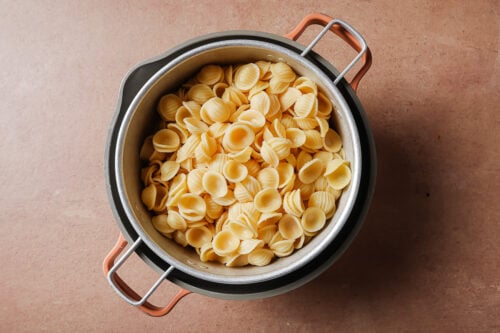
I fill a large pot with water and bring it to a full boil, then I add a generous amount of salt. The water should taste pleasantly salty, almost like a light broth. This is the only chance you get to season the pasta itself. Add the orecchiette and cook according to the package directions until just barely al dente. The pasta will finish cooking when it hits the hot skillet with the sauce, so pulling it a minute early is intentional.
Step 2: Brown the sausage.
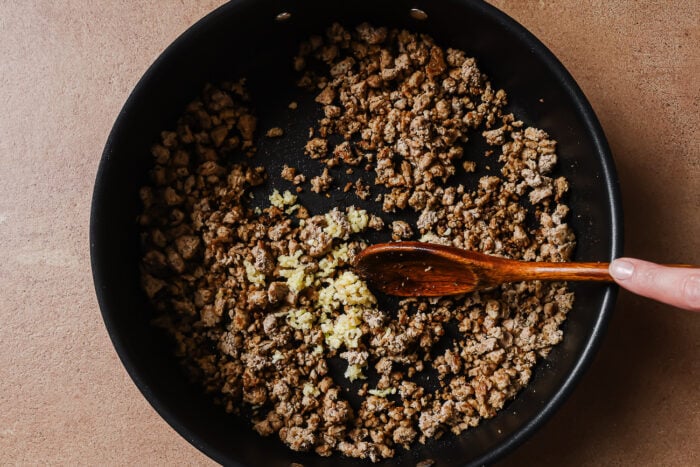
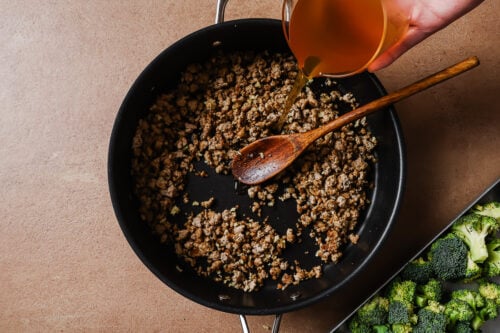
While the pasta cooks, I heat 1 tablespoon of olive oil in a large skillet over medium-high heat. I add the sausage, breaking it into irregular pieces with a wooden spoon, and let it cook for 5 to 6 minutes until deeply browned and cooked through. I resist the urge to stir it constantly. Letting the sausage sit undisturbed for a minute or two before breaking it up is what creates that golden, caramelized crust and the flavorful browned bits on the bottom of the pan. Those bits are gold. They will dissolve into your sauce and add tremendous depth of flavor.
Step 4: Build the sauce and cook the broccoli.
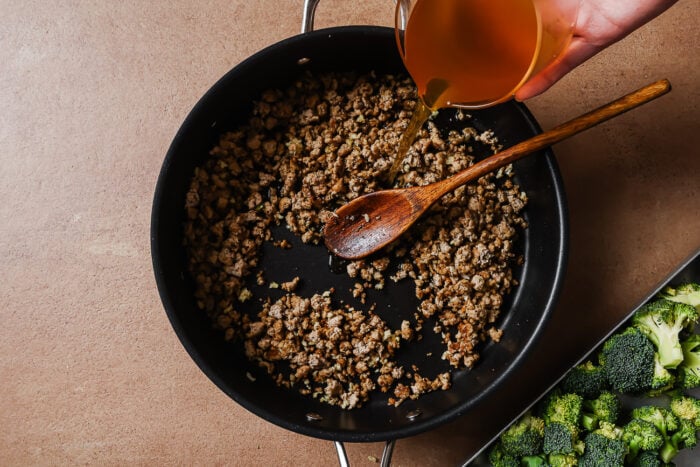
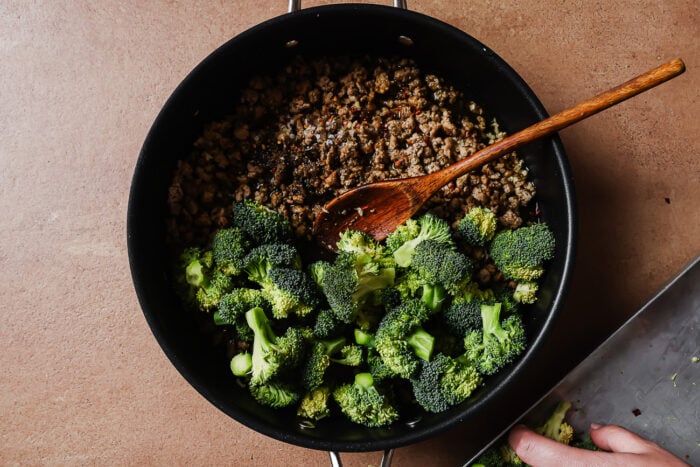
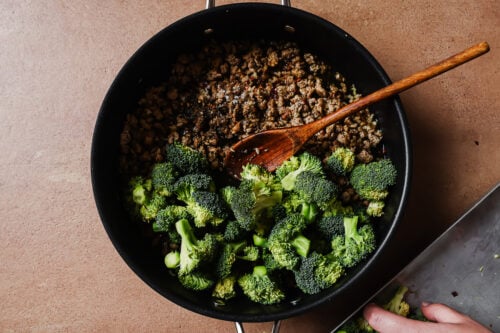
I lower the heat to medium and stir in the minced garlic. I cook it for about 1 minute, just until it is fragrant. Then, I add the remaining 2 tablespoons of olive oil, the beef broth, broccoli florets, salt, black pepper, and red pepper flakes all at once. I stir frequently and make sure to scrape up every browned bit from the bottom of the pan. That fond is the foundation of the sauce. I cook this for 3 to 4 minutes, until the broccoli is tender-crisp and still bright green, and the liquid has reduced slightly.
Step 5: Add the butter and finish the sauce.
I stir in the butter and let it melt into the sauce over medium heat. I simmer for another couple of minutes. This is where the sauce transforms. The butter emulsifies with the broth and sausage fat, turning what was a thin, brothy liquid into something glossy and coating. I can tell it is ready when the sauce has reduced slightly and looks silky rather than watery.
Step 6: Combine the pasta and serve.
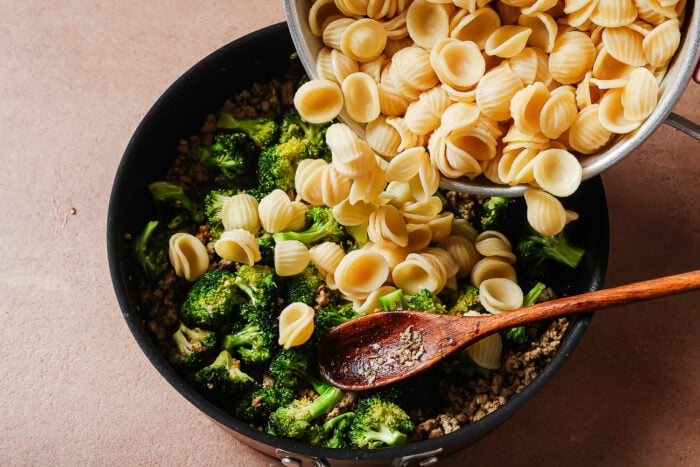
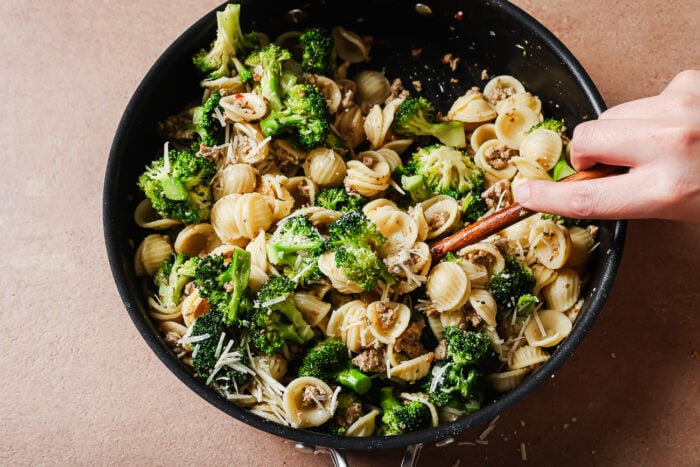
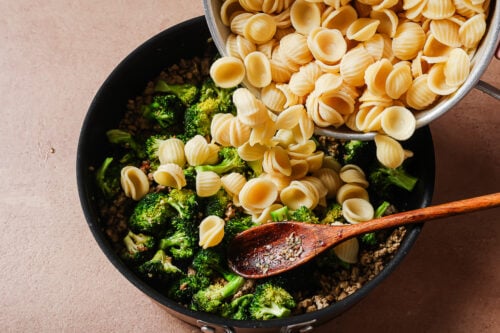
I add the drained orecchiette directly to the skillet and sprinkle in half of the grated cheese. I toss everything together firmly so the pasta absorbs the sauce rather than just sitting in it. If the pasta looks too dry, I add a splash of the reserved pasta water a tablespoon at a time until everything moves together freely. I taste and adjust the seasoning, then serve immediately with the remaining grated cheese and also a drizzle of olive oil on top.
Pro Tip: A small amount of lemon zest or a squeeze of fresh lemon juice stirred in just before serving is completely optional, but it is something I do when I want to lift the dish a little.
Recipe Tip
Do not skip saving pasta water. I set a measuring cup next to the colander before I drain the pasta so I never forget. The starch in that water is what allows the sauce to cling to the pasta. If you drain without saving any, and the final dish looks too dry or the sauce seems broken, you have no recovery option. One cup is enough. You probably will not need more than a few tablespoons, but having it on hand is the difference between a confident cook and a panicked one.
Taste before adding salt. Pecorino Romano is naturally salty, the sausage is seasoned, and beef broth carries salt too. I always taste the finished dish before adding any extra salt. More often than not, it does not need any. This is a case where the ingredients season each other, and adding salt without tasting first can push the dish over.
Serve immediately. Orecchiette with sausage and broccoli is a dish that wants to be eaten the moment it is done. As it sits, the pasta absorbs the sauce and the texture tightens. If you are making this for guests, have everything else ready before you start the pasta so dinner hits the table while the sauce is still glossy and moving.
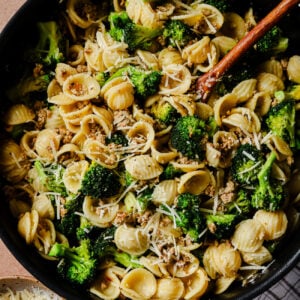

Orecchiette with Sausage and Broccoli
Ingredients
- 1 pound orecchiette
- 3 tablespoons extra-virgin olive oil divided
- 1 pound sweet or spicy Italian sausage casings removed
- 4 garlic cloves minced
- 1 cup beef broth
- 1 pound broccoli florets
- Salt and black pepper to taste
- ¼ teaspoon red pepper flakes
- 2 tablespoons unsalted butter
- ½ cup freshly grated Pecorino Romano
Instructions
- Bring a large pot of generously salted water to a boil. Add the orecchiette and cook until al dente according to package directions. Drain well and set aside.

- While the pasta cooks, heat 1 tablespoon of olive oil in a large skillet over medium-high heat. Add the sausage, breaking it up with a wooden spoon. Cook for about 5–6 minutes, until browned and cooked through.
- Lower the heat to medium and stir in the minced garlic. Cook for about 1 minute, just until fragrant.
- Add the remaining olive oil, beef broth, broccoli florets, salt, black pepper, and red pepper flakes to the skillet.
- Stir frequently, scraping up the browned bits from the bottom of the pan. Cook for 3–4 minutes, until the broccoli is tender-crisp and the liquid reduces slightly.
- Stir in the butter and let it melt into the sauce. Simmer for another couple of minutes to allow the flavors to come together.
- Add the drained pasta directly to the skillet (or return it to the pasta pot and pour the sausage mixture over it). Sprinkle in half of the Pecorino Romano and toss well to coat.
- Taste and adjust seasoning if needed. Serve warm, topped with the remaining grated cheese.
Notes
Nutrition
Nutrition information is automatically calculated, so should only be used as an approximation.
Did You Make This?
Follow @primaverakitchen on Instagram, snap a photo, and tag it #primaverakitchen. We’d love to see your recreation.









Made this for my wife and I and it was delicious! Instructions were very easy to follow and it all came together rather well. I made one substitution by using turkey sausage instead of Italian sausage. Primarily due to diet restrictions. The dish is very good and is on my favorite list.
Thank you so much for sharing! I’m so happy to hear you and your wife enjoyed it. Turkey sausage is a great substitution, especially with dietary restrictions. I love that this recipe made it onto your favorites list! 😊